OneGuard
A five-person venture built for Bath's entrepreneurship unit: training that teaches staff at financial firms to tell AI-generated content from human work. The research decided its shape, because the public would only take the course for free and employers said they would pay for it.
What it had to do
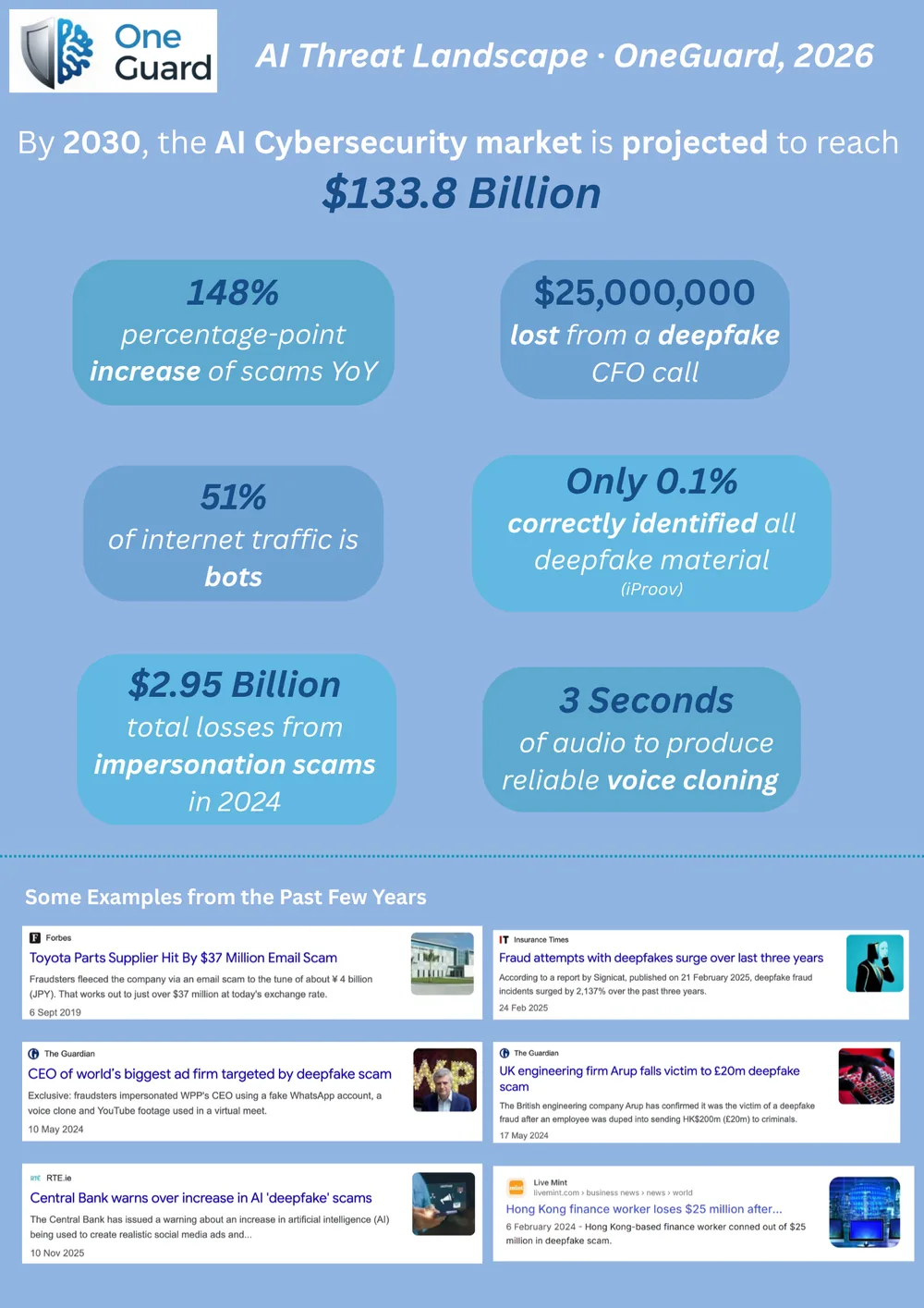
Telling machine-generated content from human work has become hard enough to be expensive. Reports of impersonation scams rose an estimated 148% between April 2024 and March 2025, the Federal Trade Commission recorded $2.95bn of losses to impersonation in 2024, and a finance worker in Hong Kong transferred around $25m after a video call in which every other participant was a deepfake.
The obvious product is a detector, and we ruled that out in the first week. Detection accuracy is a moving target: a method is tuned against the models that exist when it is written, the next release moves the goalposts, and there is an active research literature on defeating detectors deliberately. Teaching people what to look for is slower to deliver and does not expire the moment a new model ships.
The unit ran over two assessments. A written business plan in December, then a Dragons' Den style pitch to staff and peers in April, which is where the poster below comes from.
What we chose
A business-to-business platform, which is not where we started. We began by designing for the general public and the survey data moved us.
We ran two surveys: twenty-five members of the public and ten managers inside businesses. The public were concerned enough, with over 95% at least moderately concerned and 75% saying they had already been taken in by something they assumed was genuine, but 68% wanted the course to be free. All ten managers said they would provide the training, four definitely and six probably, and their willingness to pay was spread evenly from nothing up to £50 a head. The concern was general and the budget was corporate, so we followed the budget.
The interviews were my part of this, and they are what turned the pricing from a guess into a shape. A managing director told me a low per-head subscription would land where a fixed licence would not, because “lock-in contracts can often be a repellant”, while still adding up to five figures a year across a large firm.
Finance came first for two reasons. Every manager said practical, industry-specific examples were the thing that would make them follow through, and financial firms already carry audit obligations that give documented training a second use. I did the regulatory reading behind that second point. It was a surface check rather than anything a compliance officer would sign off, but it is why the pilot targets finance and not, say, recruitment.
Credibility went into the business model rather than the marketing. Over 90% of both groups said an endorsement from a university or another trusted body would make them more likely to use the training, so paying academics to verify the material sits in the cost structure as a fixed line.
How it works
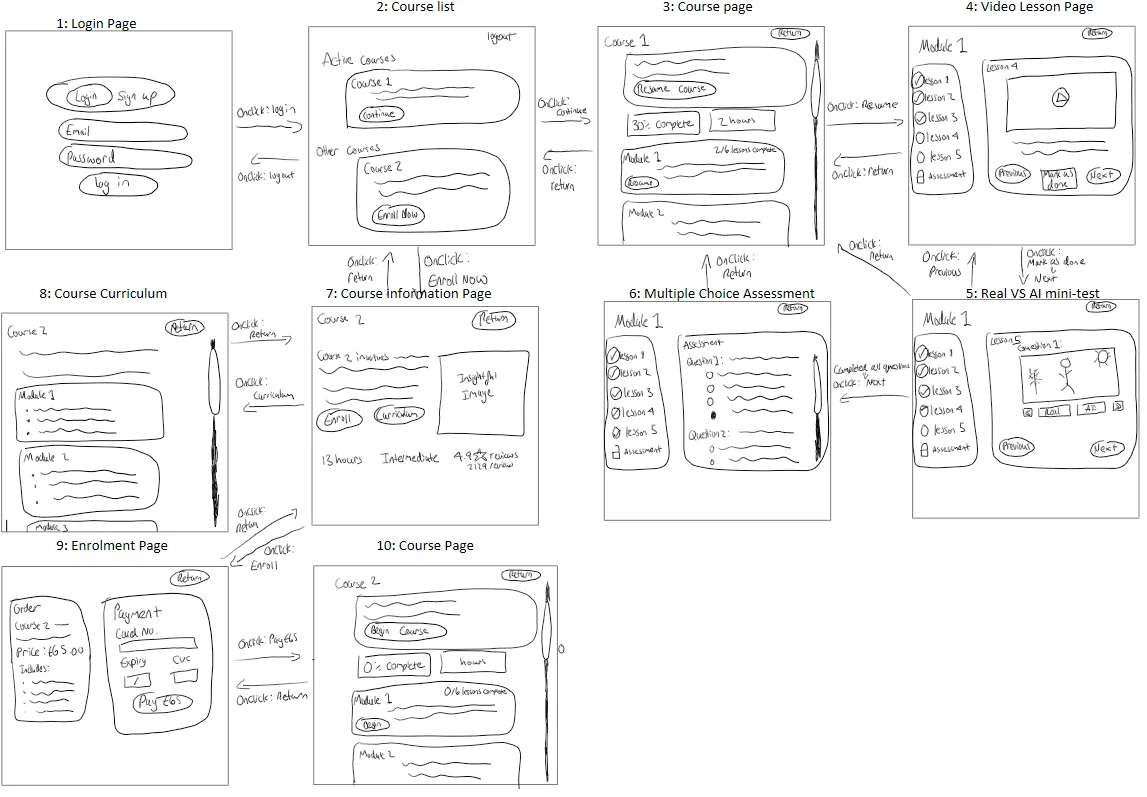
Courses hold modules, modules hold lessons, and the assessment at the end of a module stays locked until every lesson in it is complete.
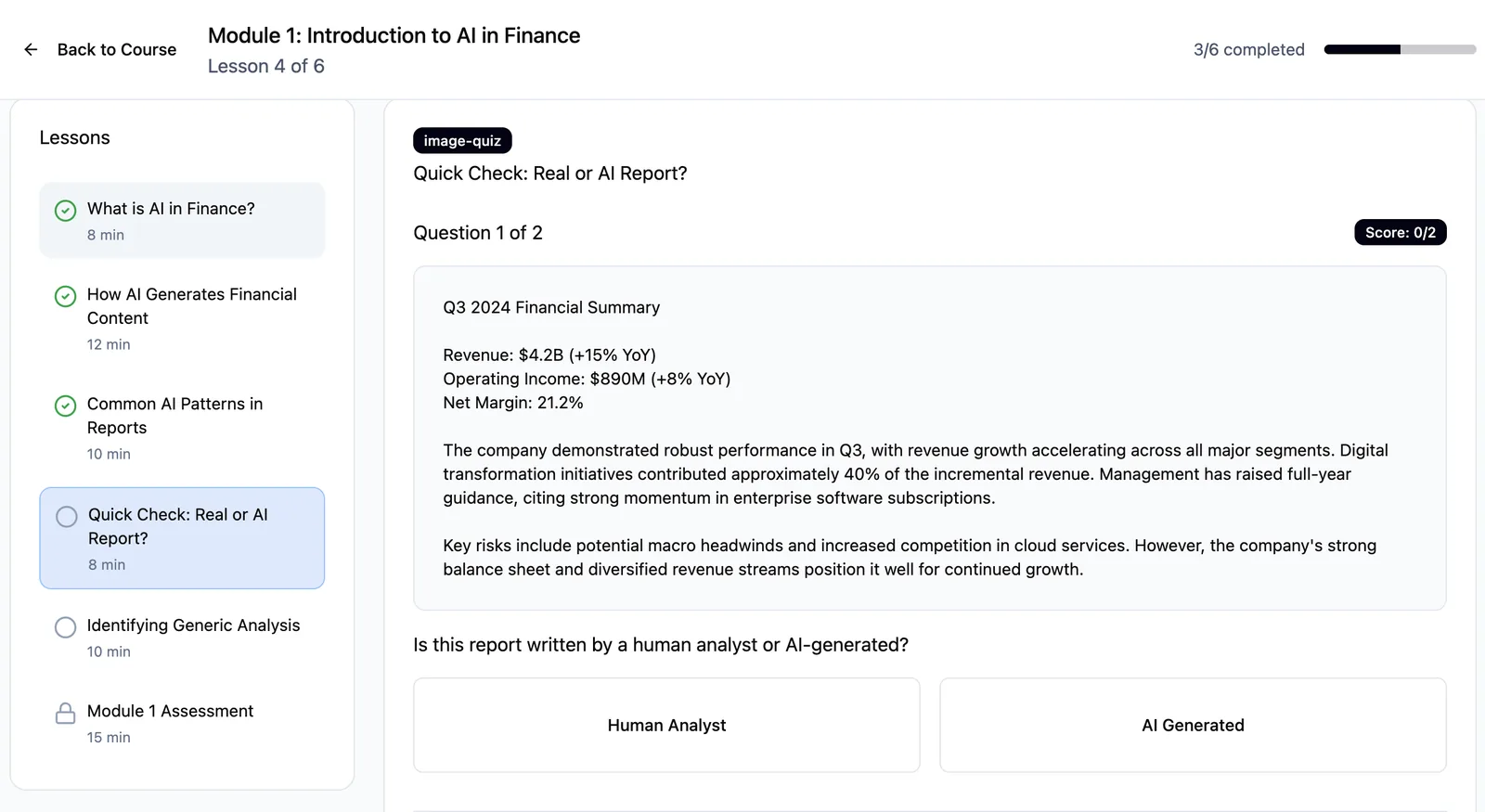
The exercise the whole thing turns on is a quick check. A learner is shown a document in a format they would actually meet at work, a quarterly summary or a market note, and asked whether a person or a model produced it. The answer is marked immediately and explained, with a link back to the lesson covering whatever was missed, and it can be retaken. The end-of-module exam uses the same questions and withholds all feedback until it is finished.
There are two ways to buy it, because the interviews produced two different asks. A catalogue course is priced per seat and bought through the site. A tailored course is scoped and negotiated directly, since every manager we spoke to wanted their own scenarios in it.
All ten screens were drawn by hand before anything went into Figma, with the transition written on each arrow. Finding out that a flow does not work costs a pencil at that stage.
What it cost
Sample size, and we put that in the report rather than leaving it to be found. Twenty-five and ten are small numbers, and every respondent was in the United Kingdom or Singapore, which bounds every percentage above.
The prototype is a Figma prototype. It clicks through convincingly, but the marking, the progress tracking and the payment are drawn rather than built, so what we tested was the design and not the product.
Testing with senior employees changed it twice. They said the white-dominated screens gave the eye nothing to hold onto, so we added colour and contrast to separate the sections and took it back for a second round. They also told us it worked better on a desktop than on a phone, which suits a corporate audience and is still a gap.
The competitor position is a snapshot rather than a moat. We found nobody training people specifically to separate human work from machine output inside a single industry. The closest were a professional certification at £950 to £1,250, a nonprofit media-literacy programme, and a local digital-inclusion charity, and any of the three could move into the space.
What we'd change
Survey the people with the budget first. We shaped the early prototype around a customer who, it turned out, would not pay for it, and only found the paying one afterwards. The pivot was cheap because nothing had been built yet, which is an argument for asking early rather than a defence of the order we did it in.